How To Beat the Afternoon Slump: The Definitive Guide To Cognitive Endurance
Herbleafy
To learn how to beat the afternoon slump, you must optimize your cellular energy by supplementing mitochondrial nutrients like PQQ and CoQ10 with Alpha-GPC.
This protocol stabilizes the prefrontal cortex, prevents the “adenosine rebound” caused by morning caffeine, and provides the clinical-strength milligram dosages required to maintain sharp focus and productivity throughout the entire workday.
And if those two sentences just left you with brain fog, then keep on reading, as I’ll explain in simple terms how to ‘Biohack’ your brain for peak all-day energy levels!
The 2:00 PM Wall (Or Afternoon Slump): Why Your Brain Is Shutting Down
If you find yourself staring blankly at your monitor as the clock strikes 2:00 PM every day, the good news is YOU AREN’T AS LAZY as the HR manager (or spouse) makes out!
This issue comes from hitting a biological wall that most of us are completely unequipped to climb.
We’ve been conditioned to believe that the solution to a midday slump is another “Megafrapachino” coffee or some (admittedly delicious) sugary snack, but these little energy-sappers are actually the primary architects of your exhaustion.
The “caffeine debt” is a real physiological phenomenon. When you consume caffeine in the morning, it works by blocking adenosine receptors—the chemicals in your brain that signal sleepiness.
However, that adenosine doesn’t disappear; it just builds up behind the “dam” of caffeine. When the caffeine eventually metabolizes around early afternoon, that flood of built-up adenosine hits your receptors all at once.
This is why your brain feels like it’s wading through mud when you need to be at your sharpest.
Circadian vs. Ultradian: The Science Behind The Afternoon Slump
To understand how to beat the afternoon slump, you must understand the two cycles governing your energy:
1. The Circadian Rhythm:
Circadian is one of those words most of us know of, but can often forget what it means. The Circadian Rhythm is the term given to our 24-hour internal clock. And between the hours of 1:00 PM and 3:00 PM, that internal clock is naturally set to lower our core body temperature slightly, signaling a period of reduced alertness.
So the Spanish are on to something with their early afternoon ‘Siestas’.
2. Ultradian Rhythms:
Ultradian Rhythms are shorter 90-minute cycles. The prefrontal cortex—the CEO of your brain as it were—can only maintain intense “directed attention” for about 90 minutes before it requires a neurochemical reset.
When these two cycles overlap, you experience the “Slump.”
To overcome it, you cannot simply “try harder” or power through—you have to upgrade your internal hardware. Keep reading and I’ll explain how…
The Hardware Protocol: Environmental Hacks For Focus
Before we address the nutritional issues causing that afternoon slump, first we must fix the “leaks” in your ‘productivity environment’. Even the best supplements can’t overcome a broken workflow for example.
1. The 2% Hydration Rule
Research shows that even a 2% drop in hydration levels causes a measurable contraction in brain tissue. This leads to a significant spike in “perceived effort”—meaning tasks that were easy at 10:00 AM suddenly feel impossible.
The Hack: At 1:30 PM, drink 16 ounces of water with a pinch of sea salt. The electrolytes ensure the water actually enters your cells to support neural firing.
2. The “Junk Light” Reset
Staring at a screen for six hours causes “ciliary muscle” fatigue in the eyes, which the brain interprets as general mental exhaustion.
The Hack: Every 90 minutes, look at an object 20 feet away for 20 seconds. This simple act resets the visual system and prevents the “brain fog” that contributes to the afternoon slump.
The Lunchroom Trap: Why Your Midday Meal Is Amplifying The Afternoon Slump
If you want to know how to beat the afternoon slump, you have to look at your plate. The standard “quick lunch”—a sandwich, a bowl of pasta, or a large smoothie—is a metabolic disaster for productivity and focus.
When you consume high-glycemic carbohydrates (white bread, pasta, sugary dressings), your blood glucose levels skyrocket. In response, your pancreas pumps out a massive dose of insulin to clear that sugar.
The result? A “hypoglycemic crash” about 90 to 120 minutes later.
Factor back in a crossover of the Circadian and Ultradian Rhythm’s and it’s no wonder all you can focus on is going to bed!
The Herbleafy “Smart Lunch” Protocol
To maintain cognitive endurance, your lunch must be designed for glucose stability.
Prioritize Protein and Healthy Fats: Salmon, grilled chicken, avocado, or nuts slow down the absorption of glucose, providing a steady “drip” of energy.
The “Non-Starchy” Rule: Fill half your plate with leafy greens or cruciferous vegetables to keep your insulin levels flat.
Avoid the “Liquid Sugar” Trap: Stick to water or unsweetened tea. Even fruit juices trigger the crash you’re trying to avoid.
The Beat The Afternoon Slump Software Protocol: Why Most Focus Supplements Fail
This is where most people get it wrong. They buy generic “brain boosters” from the grocery store.
The problem? The Fairy Dust Effect. Most companies include “trending” ingredients but at dosages so low they wouldn’t even affect a lab rat.
It’s common practice for these supplement ‘marketers’ to use 5mg of an ingredient when the clinical studies prove you need at least 150mg, but by doing so, they can market that ingredient and get their product in front of the many people searching for that currently trending ingredient.
At Herbleafy, we find that insulting. If you want to know how to beat the afternoon slump, you have to stop playing with “fairy-dusted” formulas and start using clinical-strength milligram dosages to Biohack your way to maximum productivity.
The NeuroAid Architecture: Mitochondrial Fueling
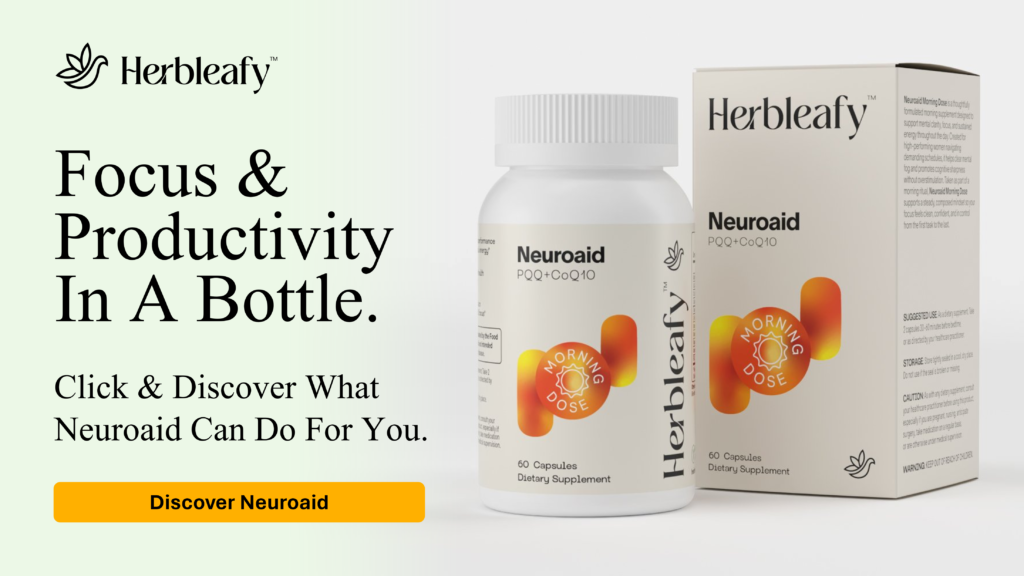
To achieve actual cognitive endurance, you need to address the “engines” inside your cells. We’ve calibrated the Neuroaid formula to handle the high metabolic demands of professional work.
Alpha-GPC (150 mg) – The Choline Powerhouse
Your brain requires a neurotransmitter called acetylcholine to focus and process information. Without enough choline, your thoughts feel sluggish and “distant.”
The Herbleafy Edge: We include 150 mg of Alpha-GPC, a highly bioavailable form of choline. This is the structural support your brain needs to maintain signaling speed when the pressure is on.
PQQ (10 mg) – Growing New Power Plants
Pyrroloquinoline Quinone (PQQ) is a breakthrough in longevity science. It is one of the only compounds known to support mitochondrial biogenesis—helping your cells actually grow new mitochondria.
The Herbleafy Edge: By providing a 10 mg clinical dose, we are effectively increasing the “horsepower” of your brain cells. While others try to squeeze more work out of tired cells, we are helping you build a more powerful engine.
CoQ10 (40 mg) – The Energy Catalyst
Coenzyme Q10 is essential for ATP production (the energy currency of your body). As we age—especially after 35—our natural CoQ10 levels drop, leading to chronic fatigue.
The Herbleafy Edge: We’ve paired CoQ10 with PQQ because they are synergistic. While PQQ builds the engines, 40 mg of CoQ10 ensures they are firing at maximum efficiency.
Ashwagandha Extract (300 mg) – The Stress Buffer
High-stakes work creates cortisol. High cortisol kills focus.
The Herbleafy Edge: We utilize a 300 mg dose of Ashwagandha, a potent adaptogen that “levels out” your stress response. This allows you to stay calm and productive instead of spiraling into “panic mode.”
L-Theanine (100 mg) & Taurine (150 mg)
To ensure the energy is “clean,” we utilize 100 mg of L-Theanine and 150 mg of Taurine.
The Herbleafy Edge: This combination creates a “smooth” cognitive experience. It eliminates the physical anxiety often associated with productivity boosters, leaving you with nothing but sharp, quiet clarity.
Procrastination or Biological Burnout?
Often, what we call “procrastination” is actually biological burnout. When your brain doesn’t have the ATP (cellular energy) required to process complex tasks, it naturally seeks out “low-energy” hits like social media scrolling.
By fixing the mitochondrial deficiency with PQQ and CoQ10, you aren’t just getting more “energy”—you are regaining the ability to choose your focus.
The Age Factor: Why the Slump Gets Harder After 35
For women in their 40s and 50s, the afternoon slump isn’t just about lunch; it’s about a natural decline in mitochondrial efficiency.
As CoQ10 levels drop with age, your cells become less resilient to stress. Neuroaid isn’t just a “focus pill”; it’s a foundational aging strategy designed to keep your cognitive “frame rate” as high as it was in your 20s.
Stop Guessing. Start Performing.
If you are serious about your output, you have to stop guessing. You could spend $200 a month buying these ingredients individually, trying to guess the ratios, and swallowing a handful of pills every morning.
Or, you can trust the calibration we’ve already done.
Neuroaid was built for the professional who doesn’t have time for a “midday crash.” It is a stimulant-free, high-dosage morning ritual designed to keep you “switched on” from your first meeting until your final email.
Frequently Asked Questions: How to Beat the Afternoon Slump
Q: Why is Neuroaid stimulant-free?A: Because stimulants are a “loan” that you have to pay back with interest (the crash). By focusing on mitochondrial health and neurotransmitters, we provide “clean” energy that doesn’t affect your sleep or cause jitters.
Q: Can I take this with my morning coffee?A: Yes. The 100 mg of L-Theanine in our formula is specifically designed to “tame” the caffeine, giving you the focus of coffee without the accompanying heart palpitations.
Q: How long before I see results?A: You will feel the cognitive support of the Alpha-GPC and L-Theanine within an hour. However, the true “slump-beating” power comes from the PQQ and CoQ10, which build up over 2–4 weeks to permanently upgrade your cellular energy production.
Q: Is it safe to take every day?A: Yes. Neuroaid is manufactured in GMP-certified, FDA-registered facilities and is designed for long-term foundational support.
Looking for home office productivity tips? I’d not be surprised as working from home offers unparalleled freedom, but it also demands an unprecedented level of